Spot session
DDR5 16Gb session avg and legacy DDR4 rows from the TrendForce DRAM spot board, snapshotted for this desk.
 DramDesk
Stacked DRAM package reacts to capacity and type. Educational visualization — not a fab CAM view.
DDR5 16Gb session avg and legacy DDR4 rows from the TrendForce DRAM spot board, snapshotted for this desk.
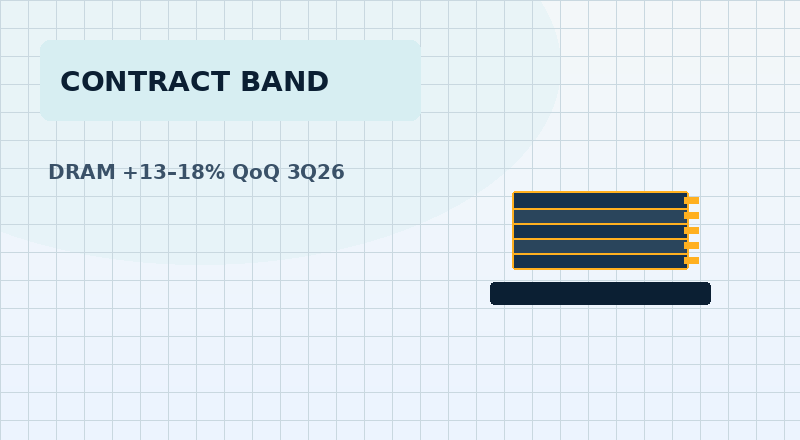
3Q26 conventional DRAM +13–18% QoQ; NAND +10–15% QoQ — TrendForce press, 3 Jul 2026.
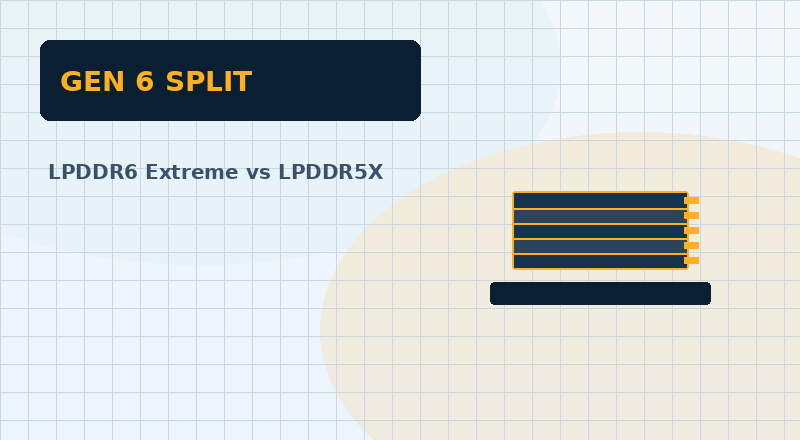
Extreme: LPDDR6 / UFS 5.0 / larger AI shared memory. Standard: LPDDR5X / UFS 4.1 / trimmed cache.
| Spec | Extreme Gen 6 | Gen 6 |
|---|
Spot session averages are transactional board prints (USD/die), not finished module retail. Contract QoQ bands are forward survey ranges for conventional DRAM and NAND Flash in 3Q26. This desk converts die averages into BOM line estimates with explicit packaging and density factors — useful for comparing builds, not for quoting a purchase order.
OEMs buy LPDDR packages and UFS in capacity bins. During a shortage, spot boards for PC DRAM move first; mobile contract follows with a lag. Raising a phone from 12GB to 16GB is not just “+33% RAM cost” — die count, package type (LPDDR5X vs LPDDR6), and yield bins all shift the line. DramDesk shows that line so you can see the tax before the MSRP lands.
| Item | Session avg (USD) | Δ session |
|---|